
Today’s buying environments are defined by information in abundance. Buyers can access analyst reports in seconds, compare competitor claims instantly, draw on AI-generated summaries, and gather perspectives from across peer networks and review platforms.
The challenge is making sense of all this information, and it’s changing how decisions are made inside organisations. In high-stakes B2B buying, decisions are rarely made by individuals. They are shaped, challenged and validated across buying groups, leadership teams and financial gatekeepers, each adding their own lens of scrutiny.
As a result, the bar for moving forward has risen, and decisions are slowing. And when deals stall, organisations often default to a familiar explanation: we must have lost to a competitor. In many cases, the decision hasn’t been won elsewhere — it has simply failed to progress at all. Momentum is being lost to hesitation, complexity and the need to achieve enough internal alignment to move forward.
Man Bites Dog’s latest research revealed that 88% of leaders say decisions stall unless they can build enough confidence across the buying committee and C-Suite. This is where a different kind of challenge emerges, one that goes beyond information, and into decisive confidence, clarity and the ability to act.

The instinctive response to buyer hesitation has long been to focus on trust. If decisions are slowing, marketers assume they need more credibility, more testimonials and more reassurance. Of course, trust matters. It earns attention, reduces perceived risk and gets brands onto the shortlist, but trust alone rarely moves decisions forward.
Our research shows that trust is no longer sufficient to create growth with 89% of B2B leaders telling us trust does not give them enough confidence to make high-stakes buying decisions. The challenge is that buyers are not only asking whether a brand can be trusted, they are also trying to resolve a set of more complex, forward-looking questions:
This is where a different approach is required. Instead of relying solely on trust signals to reduce perceived risk, organisations need to build Intelligence Advantage: combining superior ideas, expertise, data and technology to help customers navigate uncertainty and move decisions forward.
Intelligent brands don't simply demonstrate credibility; they demonstrate understanding. They combine expertise, insight, data and judgement to help customers interpret complexity, prioritise options and move from uncertainty to action.
That shift changes the role of marketing. The test is to ask - are we giving buyers greater clarity or simply more information? Are we creating confidence through an intelligent perspective, or relying on trust signals alone? Does our marketing reduce the effort of deciding, or increase it?
When helping customers understand what matters, what to prioritise and what to do next, there are three areas to consider:
Not every asset, message or proof point creates value. Audit your customer experience with a simple lens: what is genuinely helping buyers move forward and what exists because you assume more information equals more confidence?
Choice can feel exhausting. Are you presenting customers with endless scenarios, frameworks and possibilities without helping them evaluate them? Intelligent brands use judgement to reduce effort rather than put decisions back to the buyer.
Too much thought leadership still ends at awareness: it informs, inspires and then leaves customers to work out the implications themselves. Intelligent thought leadership should go further and help customers interpret change, understand consequences and feel more confident taking action.
If trust is no longer enough, Intelligent Brands need to make their capabilities unmistakable and turn their firm’s intelligence into sustained commercial growth. Man Bites Dog’s Intelligent Brands system defines six interlocking capabilities that help organisations to translate ideas, expertise, data and technology into buyer confidence. Each dimension creates value in its own right, but together, they form a systematic growth model: helping brands become more visible, more convincing and more commercially effective in complex B2B markets.
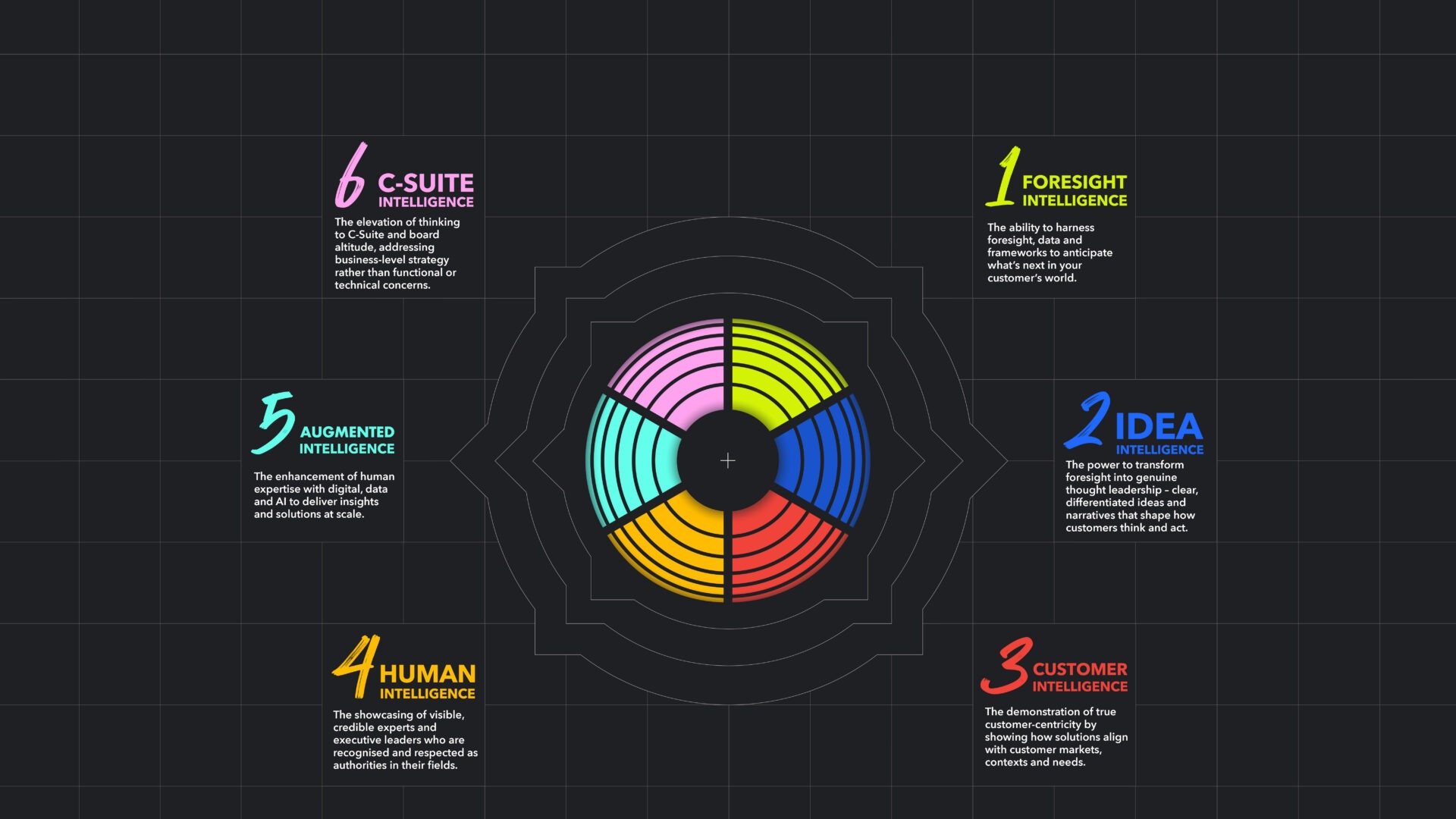
In an environment defined by complexity and choice, successful brands aren’t necessarily the ones that say the most, publish the most or even earn the most trust. They are the ones that create Intelligence Advantage: helping customers interpret complexity, reduce the effort of deciding and feel capable of acting.
Download the Intelligent Brands report to explore the data in more detail and get a practical framework to inspire decision-grade confidence in your customers.
Or get in touch with our team of B2B experts to discuss how we can help your organisation accelerate growth.
Head Office
Moore House
13 Black Lion Street
Brighton
United Kingdom
BN1 1ND
London Office
24/25 The Shard
32 London Bridge Street
London
United Kingdom
SE1 9SG
Man Bites Dog Ltd. is a company registered in England and Wales with company number 05156769. Registered office: Moore House, 13 Black Lion St, Brighton and Hove, Brighton BN1 1ND. VAT No: GB854451518.