Thought Makers: Supercharging C-Suite Sales with B2B Thought Leadership
Find out how you can use thought leadership to supercharge brand and sales.
For a discipline built on carefully crafted sentences and the all-important ‘message’, in reality thought leadership is a numbers game. And not just any numbers.
The opinions of experts are always valuable, but when backed up by powerful evidence, they become invaluable. What constitutes powerful evidence isn’t as straightforward as we often imagine – and a one-size-fits-all approach no longer works.
In the recent past, one size did seem to fit most of the time, and that one size was called ‘opinion research.’ It was the gold standard of evidence-backed thought leadership. In a world where behavioural economics loomed large that made a lot of sense.
Peoples’ opinions do still matter, in my opinion, but only regarding topics that depend on their opinion (i.e. when the outcome is heavily dependent on a particular group’s views and the responses they elicit). It is here that many recent campaigns have taken a stumble.
The headlines and boardroom debates in 2024 aren’t nearly as centred around behavioural economics as they once were. Perhaps more importantly still, the future isn’t the blank slate we used to assume, waiting to be shaped, limited only by the scope of human imagination.
Instead, the new kid on the block is environmental economics, and she’s taking no prisoners, without much care given to what anyone else thinks.
In the modern world of thought leadership data, the research methods we use and the numbers that we crunch must be applied carefully and directly to the subject at hand.
For example, if we want to understand how organisations and their employees envisage their roles being shaped by the future of technology, opinion research is the perfect tool. However, if we want to understand the reality of how cities around the world are being reshaped to meet the needs of both climate change and their citizens, opinion data will fall woefully short.
What’s the alternative? Historically the most robust and powerful forms of data have been neglected, because they are harder to work with. But economic data is starting to have its moment in the sun.
Why? Because it tells us what is happening on the ground, not what fallible humans imagine to be the case. If you’re planning your talent needs for the next five years, would you rather know what skills exist in the market and how they are changing over time, relative to demand, or would you rather know what some people think is happening?
Once again, that is not to say that opinion research is dead. It isn’t, and it has a huge amount to offer wherever behaviours are important, such as diagnosing missed opportunities or where key perception gaps exist between different groups.
However, it is no longer the only weapon in the arsenal. Organisations that neglect the tangible, robust power of real-world data will struggle to take their thought leadership from ‘interesting’ to genuinely game changing.
If you'd like to learn more about our approach to data and thought leadership, please get in touch here.
As AI transforms industries and reshapes the way we live and work, organisations need to find ways to seize the growth opportunities that AI brings, and position themselves as leaders. Intelligent brands – organisations that provide high-value, critical services and technology – must differentiate themselves through their unique thinking, expertise, and insights that help power their clients' success.
In this rapidly evolving AI landscape, thought leadership has become a crucial strategy for establishing authority and helping clients navigate what's next. However, in a world saturated with content, truly effective thought leadership must centre around a compelling "big idea" that resonates emotionally while being anchored in robust data that appeals to the intellect.
At Man Bites Dog, we've been supporting our clients to craft their big AI-dea – a powerful concept backed up with substantial data. Our impactful thought leadership campaigns are designed to navigate the complexities and opportunities of technological disruption.
Here’s a round-up of some of our recent campaigns:
The New Riskonomy for Hogan Lovells

In partnership with global law firm, Hogan Lovells, we developed a thought leadership platform focused to help organisations build resilience and thrive in an evolving world of tech risk. The New Riskonomy investigates some of the most pressing factors when it comes to technology, with a focus on the recent surge in generative AI.
We conducted global opinion research amongst 1,000 General Counsel and 500 C-suite executives to explore the complex relationship between technology-related risks and corporate performance.
The Riskonomy Radar, a counterpart tool, also enables business leaders to understand where they could be overlooking tech threats to their business and to be strategically inspired by successful sectors. Our proprietary benchmarking methodology uses scored data points to categorise organisational technology risk.
The research unveiled some concerning stats: 91% of businesses are exposed to moderate or high levels of technology-related risk. C-suite and GCs identify the top technology-associated risks to their business over the next three years as data management, cyber security, a digital skills gap and misuse of generative AI within their organisation. But three in five (60%) admit their business is not taking a positive, proactive approach to technology-associated risks and doesn’t have the appropriate strategies and policies in place.
The campaign was supported with an interactive microsite. The findings are distilled into four chapters exploring organisational vulnerabilities. This was supported with sector-focused versions of the report and roundtable events.
Explore the campaign here.
The Next Organization for Mayer Brown
To help our client, Mayer Brown, a leading international law firm, reach its goals of helping its clients turn critical, complex, and challenging issues into opportunities for growth, we partnered with them to create ‘The Next Organization.’
Based on global research, ‘The Next Organization’ explores the perspectives of leaders at financial services firms on business transformation – along with their assessment of their organisation’s readiness to thrive in “the next economy.”
Unsurprisingly, AI emerged as a key theme as it reshapes the business landscape. Business leaders are becoming increasingly anxious that the speed of technological change is leaving their organisations exposed and unable to keep pace.
Key findings:
Seven in 10 business leaders (72% of financial institution leaders and 73% of investment firm leaders) say that AI developments are moving so fast that their organisation is not able to transform quickly enough and risks becoming redundant.
71% of leaders of financial institutions and 83% of leaders in investment firms believe that in the next three years, pervasive AI will have a big impact on the market environment.
Only 26% of leaders of financial institutions and 34% investment firm leaders believe they have a clear and future-ready strategy in place for AI, and the majority of both financial institutions and investment firms (65% and 67% respectively) have AI transformation strategies that only look 12 months ahead.
Read more findings in the report here.
Can AI-powered productivity solve the talent crisis for Mercer
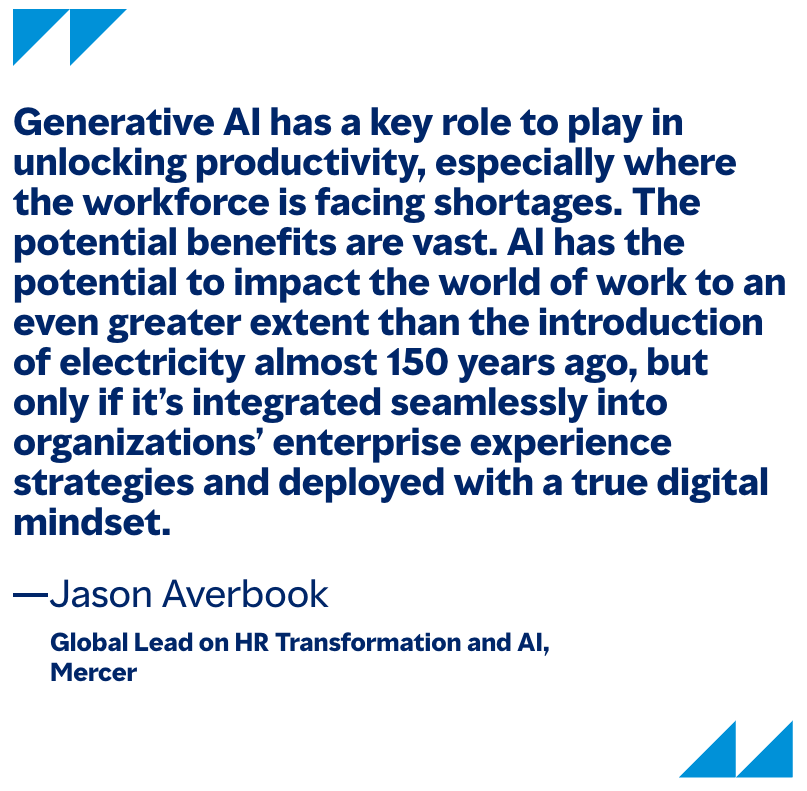
Can AI-powered productivity solve the talent crisis? We worked with professional services company, Mercer, to find out.
We developed an economic model that revealed that AI’s potential to boost productivity could offset the headwinds from changing demographics and a shrinking skilled labour force. However, AI will not disrupt countries and sectors equally, with the finance sector predicted to see productivity gains of 14% compared to 3.1% in the hospitality sector.
According to the modelling, AI-driven productivity gains could free up 36 workdays a year for the average worker. The companies that embrace the opportunities created by AI will stand firmly on the shoulders of robots, unlocking unprecedented levels of innovation and efficiency.
You can read the full study here.
If you’d like to learn how to craft your next big AI-dea, contact one of our thought leadership experts here.

In the energy sector, transformation is a necessity. As organisations try to navigate the urgent call for sustainability and grapple with the challenges of climate action, the energy sector finds itself at the nexus of some of the biggest trends shaping the global economy.
From the phase-out of fossil fuels to the rise of renewables, the energy landscape is continually evolving. Renewable energy technologies such as wind and solar power are expanding rapidly. By 2028, renewables are expected to account for over 42% of global electricity generation, with wind and solar doubling their share to 25%.
Amidst this change, one thing remains clear: the need for strategic direction. Strategic thought leadership is not just about staying ahead of the curve — it’s about shaping it. With the energy sector responsible for nearly 73% of global greenhouse gas emissions, the pressure to reduce carbon emissions and embrace the energy transition is immense. Strategic thought leadership can play a key role in guiding the industry forward by driving innovation and steering it toward a sustainable future.
So, with this in mind, let's look at three key ways strategic thought leadership can create a transformative impact.
Powerful thought leadership – content from a business brand, based on a strategic idea and backed up by robust data – can help to set the agenda in a fast-changing sector. It can be a medium for exploring sustainable innovation, quantifying the impact of transition, and demonstrating the risks of inaction. From renewable energy sources to energy-efficient practices, strategic thought leadership content can explore and highlight sustainable solutions that not only meet the needs of today but safeguard the planet for tomorrow, potentially helping to accelerate their development and adoption.
The journey towards sustainability is not one that can be undertaken in isolation. Collaboration is key, and strategic thought leadership can help to forge impactful partnerships. Thought leadership campaigns – including content, events and coalitions – can bring together industry stakeholders, policymakers, and environmental advocates, fostering an environment of shared purpose and collective action. Organisations can amplify their impact and accelerate progress towards common goals.
Strategic thought leadership embraces a call to action, championing disruption and innovation as drivers of progress. It’s about envisioning a future powered by clean, renewable energy and working tirelessly to make that vision a reality.
A recent example of thought leadership shaping the agenda is GHD’s SHOCKED: De-risking the energy transition which found that 97% of energy sector leaders fear the current crisis is the worst ever and that it has wiped $203 billion from investment levels. The research was launched at Reuters Global Energy Transition 2023 in New York, brought to COP28 in Dubai and taken on a global client roadshow by the GHD team.
Strategic thought leadership has the power to revolutionise industries by fostering collaboration and driving transformative change. By uniting diverse stakeholders under a common agenda, industry leaders can face challenges that transcend individual organisations.
At Man Bites Dog, we understand the unique challenges facing the energy industry and we’re committed to being part of the solution. Through our strategic thought leadership services, we empower organisations to navigate the complexities of the transition towards sustainability, driving innovation, fostering collaboration, and shaping a future powered by clean, renewable energy.
As the energy industry undegoes a change transition, the need for strategic thought leadership has never been greater.
In our latest webinar, 'Uncharted Waters', Man Bites Dog’s Sean Farrance-White was joined by water industry experts Ania Grobicki, Lead Water Advisor at the Food and Agriculture Organization of the United Nations, Rod Naylor, Global Water Lead and Kathryn Newland, Marketing Communications Lead at GHD.
Using the award-winning Aquanomics thought leadership campaign as an example, the panel highlights how impactful sustainability marketing can elevate an organisation’s reputation and help build relationships, generate revenue and create real-world impact.
The panel explored how the Aquanomics campaign was developed using Man Bites Dog’s 4D strategic ideation model. Our team identified an opportunity to quantify the economic impact of global water risk, alongside in-depth research and expert interviews to form the basis for the content. The research revealed that droughts, floods and storms could wipe $5.6 trillion from global GDP between 2022 and 2050. Aquanomics boosted GHD’s brand visibility and empowered the firm to share its message at the UN’s Conference of Parties (COP) for the first time.
Watch the Webinar now to learn:
You’ll come away with:
To find out about how we can help your brand create stand-out, award-winning thought leadership, and the benefits of using diverse content forms to enhance the reach and impact of your campaigns, please get in touch here.
This technology marketing masterclass – hosted by Man Bites Dog’s Head of Technology Division Fiona Buckley and featuring Patrick Cassleman, Senior Director, Sustainability Center of Excellence at Intel and Man Bites Dog CEO Claire Mason – explores marketing at the convergence of sustainability and digitalisation.
For business leaders, technology plays a paradoxical role in the sustainability agenda. This is because fundamental business functions such as global computing, data centres and data transmission networks are inarguably significant contributors to carbon emissions, water use and e-waste. There is a scale that needs to be balanced: demand for computing performance vs reducing environmental impact.
In this webinar, the panel discussed The Sustainable CTO, a global thought leadership platform developed by Man Bites Dog and Intel, which shines the spotlight on tech leaders as pivotal sustainability influencers in the corporate C-suite. Patrick, Claire and Fiona explain how Intel has used this platform to engage with C-suite buyers and supercharge sales.
The panel also dived into The Sustainable CTO, a thought leadership initiative created for Intel in partnership with Man Bites Dog. The study gathered insights from 2,020 global business leaders from 22 markets to share their triangulated perspectives as CTOs, CEOs and chief sustainability officers (CSOs) in the world’s largest companies. The Sustainable CTO initiative introduced a new model of tech leader with the potential to become the greatest driver of sustainability in the corporate C-suite. Man Bites Dog positioned Intel as a thought leader in sustainability by moving the agenda beyond ‘tech zero’ to ‘tech positive’.
Tech Zero: Reducing the carbon footprint of an organisation’s IT function.
Tech Positive: Using technology as a lever for the whole organisation to reach its net-zero goals and to have a positive overall impact, driving business growth and accelerating innovation.
The webinar also broke down five practical steps to successful thought leadership.
Fiona, Patrick and Claire discussed the power of implementing all five of these elements to see both internal and external results across your organisation. Specifically, the panel discussed the opportunity that this content can bring to sales teams. By giving them original data on a topic of key interest to their client's business success, such as sustainability, they can have informed and educated conversations with those clients, forming stronger relationships.
To learn more about the power of thought leadership and what it could mean for your organisation, reach out to us at [email protected]. For the latest updates on Man Bites Dog events and content, register for future event invitations here, or follow us on LinkedIn.
In our webinar, ‘Return on Inclusion’, Man Bites Dog’s Divisional Director, Duncan Sparke, and Associate Director, Lauren Street were joined by financial services industry experts Farmida Bi CBE, from Norton Rose Fulbright, and Dominic Traynor, from BNY Mellon. The session covered how the financial services industry has the ability to not only advocate for major societal change, but to power it. For that reason, no-one else can quite match the potential of financial services marketers to catalyse progress.
To catch up on the webinar, watch the recording below.
The panel discussed the importance of creating impactful social purpose campaigns that cut through the noise. The problem with social impact campaigns, however, is that having a widespread real-world impact doesn’t happen overnight. Our webinar looked at the success factors in building a truly impactful social purpose marketing campaign, and unpacked one particular campaign that echoed around the world: BNY Mellon Investment Management’s The Pathway to Inclusive Investment – flipping the narrative from one of individual risk to one of global opportunity.
The webinar centered around the financial services sector and the pivotal role it can play in fostering positive social change. It touched on the importance of addressing the gender investment gap, and the intersectional complexities that play a role – from culture, and ethnicity, to socio-economic opportunity. The combination of these challenges and financial services’ ability to drive social evolution is a vital interplay.
The topics discussed during the webinar helped to illustrate the importance of the industry engaging with governments, and educational institutions, in an effort to tackle the societal pressures that sit at the cause of the investment gap dilemma.
An example of a purpose-led thought leadership campaign that successfully followed these principles is BNY Mellon Investment Management’s The Pathway to Inclusive Investment developed in partnership with Man Bites Dog. This social impact campaign is the largest study into global female financial inclusion. It found that the investment industry excludes 72% of women, and costs the global economy more than $3.22 trillion. It found that solving the inclusion crisis would open up an additional 1.86 trillion to fund climate and social investment aims.
During the Q&A session, several critical topics were addressed such as:
Organisations need to be committed to the long-term result with social impact campaigns. Having leadership buy-in and setting the parameters of success as real-world change beyond the immediate top-line advantage is crucial. Cutting through the noise, and delivering a campaign that is truly impactful, with data-driven insights is key in turning the dial on change.
To kickstart your brand's sustainable go-to-market strategy, reach out to us at [email protected] and explore our sustainability marketing solutions. For the latest updates on Man Bites Dog events and content, register for future event invitations here, or follow us on LinkedIn.

At Man Bites Dog we spend a lot of time thinking about megatrends. Over the last year we have calculated the financial returns on climate adaptation in emerging markets, delved into the impact of the global energy crisis and explored the role of technology leaders within organisations in pushing through sustainability initiatives. Often our thinking on these megatrends involves trying to find a new counterintuitive angle, or exploring how trends currently impacting businesses might interact with each other.
But in 2024, one megatrend – and two letters – is dominating our thinking more than any other: AI. Depending on your perspective it’s either coming for your job or it will save humanity. The reality is probably somewhere in between, but what is certain is that it will change (almost) everything. Recent trials of Microsoft’s GPT-powered Copilot found 70% of knowledge workers said they were more productive when using the AI tool. Repetitive tasks in the accounting and legal professions are set to be automated out of existence, whilst the application of AI to some of the complex industrial processes or the creation of “digital twins” will create huge real-world efficiencies. And anyone who has attended a marketing event or scrolled through a social media timeline recently (i.e. everyone) is met with fevered speculation about how generative AI will disrupt the marketing industry.
However, it is perhaps using artificial intelligence to tackle the biggest and most complex challenge of them all – the climate crisis – where it will have the greatest impact. To achieve a global net zero, the next 25 or so years will require a transformation of business the likes of which the world has never seen. The energy sector needs to decarbonise first and fast (see Supercharging Net Zero, our research project with Arcadis) whilst hard-to-abate sectors such as steel manufacturing will need to revolutionise their processes to produce products without fossil fuels. The full might of international capital markets will need to be thrown at millions of decarbonisation projects across the globe and, in a world of rising sea levels and increased extreme weather events, we will need new and innovative technologies to help communities adapt.
The good news is – it’s already happening. AI is already being used to intelligently manage power grids to ensure supply better meets demand and it is running as efficiently as possible. The technology is being integrated into accounting software to help businesses track their scope 3 carbon emissions. And the potential for ‘industrial AI’ to optimise processes – and therefore reduce emissions – in the advanced manufacturing, built environment and infrastructure sectors is huge. However, even to the giddiest techno-optimist, it's clear that the huge amount of data centre capacity needed to underpin ubiquitous AI will lead to an equally huge carbon footprint. According to some estimates, the tech sector as a whole could account for a whopping 14% of global emissions by 2040.
But what does this mean for B2B marketing teams and their thought leadership? As with all disruptions for forward-thinking B2B organisations, the AI revolution creates opportunities for growth as their clients seek guidance on what happens next. By undertaking research-backed thought leadership around the impact of AI on the sustainable transition within their sector, marketing teams can cater to that demand – helping their customers navigate the disruption and seize the opportunity of AI.
Does this sound relevant to the conversations you're having with your clients? Get in touch with the Man Bites Dog team to find out how we could help.

In a crowded market, the pressure is on professional services marketers to cut through the noise. Over the last decade, marketing has become too focused on quantity instead of quality, with 1.5 quintillion bytes of content produced every day, and 2.5 billion blog posts published each year. As generative AI becomes more mainstream, this content load is set to exponentially increase.
Storytelling – the world’s oldest communication technology – is a powerful way for professional services marketers to connect with clients. The question is, what stories are we telling today, and are they resonating? And how can we ensure our stories build our firm’s reputation, generate revenue, and create real-world change?
The thought leadership equation: a big idea plus substantial data
Well-told stories are powerful – with some even lasting a lifetime. To capture our hearts, they need to be interesting; they need a big idea. But as well as engaging our emotions we also need to appeal to the intellect – the rational part of the brain responsible for logic, problem-solving, organisation, and decision making. And to do this we need to communicate substantive information or data as part of the story.
We’re surrounded by a blizzard of information all day, every day – and we don’t remember raw facts. There’s just too much of it. It’s only when you put data behind a big idea, that we engage with the facts, remember them, and act on them. To create effective thought leadership we need data-driven stories that have a big idea at their core to stir our emotions supported by substantive data to engage our intellect.
This is the Man Bites Dog thought leadership equation:

There are five steps to harnessing data-driven thought leadership, requiring us to be strategic business partners to our clients and stakeholders:
To be a thought leader you must lead, not follow. Forward-looking, predictive insight is much more valuable than retrospective review. But how do you develop a credible vision of what’s next? There is a whole toolkit of options to help you see trends beyond they break. This includes using scenario planning to imagine potential futures, economic modelling to understand and anticipate trends, and sophisticated opinion research – often amongst niche audiences – to get to the heart of an issue.
Find a strong core idea that will set you apart and make a mark. This is not about following the crowd; it’s about telling people something new and different – a radical ‘man bites dog’ concept that involves against-the-grain thinking.
A signature big idea is the “north star” to unify all your content, that is scalable and sustained for years to come to give you cumulative impact. Professional services marketing tends to cluster around the same themes, so it is critical to instead choose an emerging, pre-topical issue your firm can own. This is especially true for crowded spaces such as sustainability or M&A, where you need to work even harder to make sure your big idea is new and different enough to stand out.
And while you can encompass a huge amount of detail within your campaign, you must be able to distil it into a single strong core idea that can be said in a sentence. A theme isn’t specific and new enough to be an idea – but a theme might help you scope out a starting point.
Once you have a clear idea, it needs to be substantiated with evidence by generating new, proprietary data. A common error is to conduct ‘state of the nation’ surveys to find out what people think on a given broad topic area, hoping to find something interesting and retrofit a narrative. This is a high-risk approach, which is likely to lead to unremarkable results. Instead, start with the end in mind, using your strong core idea to guide focused research. It’s the difference between a vague fishing expedition and following a treasure map to achieve your goal.
Effective thought leadership is based on a strategic idea that is anchored in your strategy to create a clear call-to-action for your services. To ensure that the idea translates into sales, it must be grounded in your business and connected with what your firm is selling. Linking the campaign to a “gateway service” such as an assessment tool or a benchmarking exercise enables business development teams to convert opportunities into revenue. Campaign-linked gateway services are also a great way of tracking marketing-influenced sales because everyone who buys the gateway service has come through your programme.
The fifth and final step is about winning attention and engagement. It involves unleashing your experts and engaging others in your story to build your reputation, relationships, revenue, and real-world impact. It means tailoring your campaign content to suit a multi-channel, multi-device world.
You will need to adopt an omnichannel approach aligned with the big-picture vision set out in your global campaign strategy to land your content and messages and ensure they have maximum impact.
Defining what’s next
While drumbeat content, reactive marketing strategies, and pulse campaigns all have their place, to truly make an impact and develop a differentiated voice for your firm, you need a big idea that can galvanise your whole organisation and provide a “north star” for all your content and marketing efforts. Much of today’s marketing and sales content lacks a story to engage our hearts and lacks data to intrigue our minds.
Impactful, strategic thought leadership puts the focus squarely back on quality over quantity. Strong thought leadership involves creating and amplifying big ideas; ideas that can define what’s next. It can increase your impact and grow your business, but it can also start movements, shape new markets, enrol followers, and create real-world change.
The demand for genuine and engaging thought leadership is higher than ever before. Recent Man Bites Dog research found that 76% of business leaders more likely to do business with professional services firms that they see as thought-leading experts in their field.1
As professional services marketers face greater competition than ever, it is critical to use the thought leadership equation to differentiate your firm from its competitors and cut through the ever-increasing noise. If you'd like to learn more about thought leadership for professional services, contact us at: [email protected].
Today, we find ourselves at a remarkable inflection point. Events over the past few years are transforming how we think about the future and the new economy. The opportunity for lawyers is to put themselves in their clients’ shoes and help them identify and react to the new set of challenges that lie ahead.
But what is next? Can you clearly see the future you will help your clients to navigate? Does your firm have compelling future thinking to share? Importantly, have you defined a new vision for your firm? Legal marketers need to be the navigators of what’s next.
The challenges facing leaders and the organisations they lead include decarbonisation, hybrid working and digital transformation, to name a few.
Not only are your clients having to handle these issues internally, but they are also under increasing pressure to share their thinking to bring about clarity and direction.
Today every CEO is expected to be a thought leader which means that your clients are now competing with you for share of voice on these crowded topics.
Future vision and orientation are becoming even more important than past performance in securing investment, as business leaders recognise that they need to be seen as innovators in order to build reputation, deepen relationships and ultimately generate revenue. To be seen as trustworthy experts you must be more knowledgeable than your clients and be generous with that knowledge. That’s the value you can bring.
With clients judging your firm’s capability and innovation on the quality of your thought leadership, it is crucial to crystalise your strategic agenda. Carving out time now for the market-making activity that will drive your firm’s business success in three to five years’ time is more important than ever.
So how can we go about advancing that strategic agenda for the years ahead?
The first step is to define the area of focus for your future thinking. Man Bites Dog’s 4D strategic ideation model presents a process to guide this thinking:
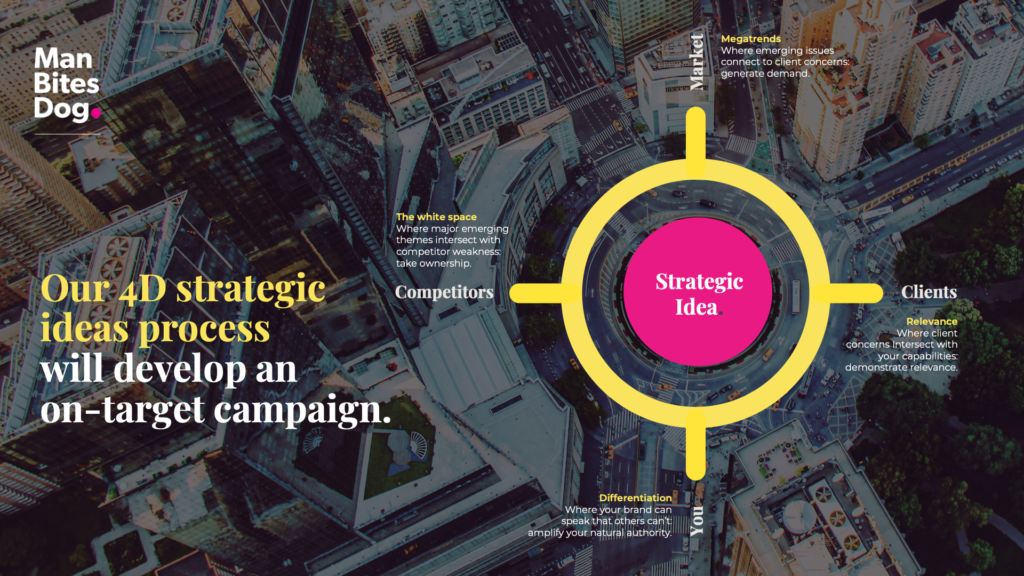
By combining these dimensions, you can shortlist a few promising opportunity areas or themes for the firm. Next, select a theme that is broad enough to act as a unifying umbrella – a golden thread that connects all (or most) of your services - in an emerging space that will help you deliver future growth. This is where you can win in the future. This is your strategic agenda.
Once you’ve developed a vision of the next economy and defined what your role in it might look like - your strategic agenda - you then need to take this vision to the next level.
The key to carving out a thought leadership position is having a strong core idea, especially as there can be a tendency for thought leadership to cluster around the same issues. To avoid thought followership, you need to have something new and different to say – a radical concept that is against the grain – and be able to distil this into a single core story.
There is power in telling stories with numbers. Backing up your idea with evidence by generating new proprietary data is essential. When it comes to research, it is important to build a new toolkit to be able to see further forward and evidence your insights with a reasonable degree of credibility and accuracy.
In a world where organisations are increasingly judged on the quality of thinking they share, forward looking, predictive insight is much more valuable than retrospective. To be a thought leader you need to shine a light on what’s next.
The future-ready legal marketer has a critical role to play in developing and communicating your firm’s future thinking, both in terms of articulating your firm’s vision in your thought leadership campaigns and how it informs new marketing-led products and services to help your firm lead in the new economy.
We are now living in disruptive times. Business leaders in your company, your clients and prospects are all worried about one thing: the future. For their company, their career and even for their children.
While leaders in emerging markets remain optimistic, Western leaders fear a rapidly approaching dystopia. Man Bites Dog’s recent research reveals that the majority of large corporate CEOs believe their own company’s past is brighter than its future. And in this dystopian future the mighty will fall: leaders expect 1 in 6 large competitors to fail by 2023.
We have now passed the tipping point where leaders are more worried about non-traditional competitors than long-standing rivals. And the biggest corporate killer is expected to be their own fickle customers.
One CEO described the new leadership paradigm to me as the difference between driving a car (something else that will soon be obsolete) and riding a motorcross bike. Leaders are now offroad and running their companies faster than ever before, so they must point their strategy further ahead while scanning for competitors in their peripheral vision.
This creates a critical challenge for business leaders because human beings are very poor at anticipating the future with any degree of accuracy. Which means visionaries now have unprecedented influence. Clients are looking for experts who can see beyond these limits. In this uncharted territory, there is a clear opportunity for companies to pivot from past precedent to future orientation: becoming the trusted navigator who, rather than fearing the future, embraces change and sees further.
The old tokens of credibility - best practice, tradition and track record - may now work against you by consigning you to the history books. The ability to adapt again and again is now our best predictor of future success. We are entering an era when credibility must be balanced with agility.
This puts us in the business of predicting the future. And thought leadership holds the key.
Man Bites Dog defines thought leadership as: a strategic idea with the purpose of gaining and conveying competitive advantage by sharing value.
Your strategic idea should strike the right balance between telling your clients something valuable and genuinely new, and promoting a problem you solve, connected to your brand, your product and services, and your area of authority.
Thought leadership is not a tactic: an isolated article, a reaction to breaking news or regulatory change. It’s a strategy: holistic corporate thinking should lead thought and lead your marketing activity.
Thought leadership is also certainly not thought followership. In an era when the speed of the innovation cycle means you can no longer differentiate on your products and services, the only battleground you can win on is your distinctive thinking.
Strategic ideas demonstrate your future orientation and reinforce your authority as a navigator - it’s all prospects have to go on that you are the go-to experts.
So how can you harness the power of strategic ideas to win?
There are 5 key considerations, for which IDEAS provides a useful acrostic:
We are living in uncertain times. But you can choose whether to disrupt or be disrupted. You have an opportunity to be the navigator - to see further and share future-oriented ideas that genuinely solve clients’ real challenges.
The future belongs to visionaries and in the ideas economy the biggest thinkers will win. Shouldn’t that be you?
Originally published on British American Business
The future of retail dropped in New York this weekend in the imposing shape of Hudson Yards. Presided over by Thomas Heatherwick’s stunning “Vessel”, the worlds of architecture and marketing collide in this instagram-breaking rebirth of the shopping experience.
The $25 billion development boasts one million square feet of retail, food and culture built for social shared experience in person and online, with every square metre constructed as a photo opportunity.

A prime example of marketecture in action, the development harnesses the power of Heatherwick Studio’s escheresque climbable sculpture to take the opening of a new shopping centre to new levels of consumer and media engagement.
Two decades on from the start of my career, launching UK retail destination Bluewater’s “male creche” strategy for “parking” bored partners, the crowds were at capacity this weekend with a balanced gender demographic (I am assured the guys are here voluntarily) and even a few four-legged friends.
Can kill become cure for the future of physical retail? While online shopping may have won the first round against bricks and mortar, the troubled retail sector has come back fighting with this immersive social media playground. Worlds collide in Hudson Yards with the Floor of Discovery hosting purpose-built showcase stores for born-online brands who are finding online customer acquisition increasingly expensive. Could more agile and enlightened lease arrangements be the key to unlock a brighter future for retail real estate and the high street?
Fellow British export Heatherwick’s example of British American collaboration provided an inspiring start to Man Bites Dog’s week of meetings and keynote speeches in New York.
We saw a lot of fun and a lot of social engagement but not a lot of shopping bags. While the jury’s out - we’re in.
Man Bites Dog is an award-winning thought leadership consultancy with global reach. Find out more at www.manbitesdog.com
Welcome to Man Bites Dog’s monthly trade blog. Our international trade thought leadership team helps organisations capture their share of the global trade opportunity. Working with clients in sectors from professional and financial services to technology and logistics, we develop visionary thought leadership, world-leading new data sets and digital client engagement tools to help position clients’ expertise and generate demand for their services. Our regular articles will provide perspectives on a key issue in global trade.
At the time of writing, waves of violence and detentions have flared in Harare after the country’s first post-Mugabe elections, with the Movement for Democratic Change’s (MDC) Nelson Chamisa and the interim ZANU-PF President Emmerson Mnangagwa vying for leadership of the southern African country once famed as ‘The breadbasket of Africa’. Mnangagwa was victorious but only narrowly avoided a run-off with Chamisa, amidst claims of vote rigging from the MDC. It appears that substantial political tensions will remain, but will the election process prove enough for Zimbabwe to continue its journey back to the world of international trade and investment?
Since the end of the Mugabe-era last year, the interim Mnangagwa Government was working to rebuild Zimbabwe’s status in international trade and investment, particularly with regard to the once-famed agricultural sector, welcoming a number of international trade delegations. Before 2000, agricultural exports were responsible for as much as 15% of GDP and and 33% of export earnings; 70% of Zimbabweans’ earnings are dependent on the sector (World Bank). The Government has been proactively supporting the sector through the Command Agriculture and Command Livestock programmes, both largely funded with private sector partners. Command Agriculture, in essence an import substitution programme, has been controversial particularly with regards to timely repayments by beneficiaries.
Whilst individual programmes may prove problematic, it is at least encouraging that the Government, over the latter years of Mugabe-rule and the interim Mnangagwa presidency has proactively sought to support the development of sustainable agricultural industries after the crises of the 2000s. A recovering agriculture sector combined with a more welcoming business environment will be a vital in bringing Zimbabwean exports back to consumers and for attracting the international investment the market needs.
Zimbabwe is not just endowed with an environment that would support a vibrant agricultural sector but it is also rich in natural resources. The Chamber of Mines of Zimbabwe has predicted that in 2018 the mining sector will grow by 10% with the sector expected to be worth £30bn by 2030. In March the Government signed a $4.2 billion deal for a new platinum mine and refinery, a substantial boon for the administration.
As would be expected, particularly since the departure of Mugabe, much has been made of Zimbabwe’s potential in the press; throughout Mnangagwa’s interim presidency he declared the country ‘open for business’. However, the country needs to continue reforming to attract greater international investment and improve its situation with its international creditors. Positively, the complex indigenisation law, which proved such a barrier for international companies, was amended earlier this year with only the diamond and platinum sectors now requiring 51% local ownership. Even within these sectors there is some discretionary flexibility permitted. Whilst some sectors are officially reserved for local businesses the amendment also permits exemptions under special circumstances. The racial overtones of the original law have also been removed. This marks a substantial change in the law, which will operate in a vastly different way to the protectionist focus of the original.
Over recent months, it would seem that Zimbabwe has finally grasped the nettle and put economic development and engagement with the international community at the heart of policy making. However, the recent elections appear to be testing Zimbabwe’s nascent democratic structures to their limit. Whatever the coming months bring, the new administration will have to work hard to maintain momentum to ensure that Zimbabwe is genuinely open for business.
Find out how you can use thought leadership to supercharge brand and sales.
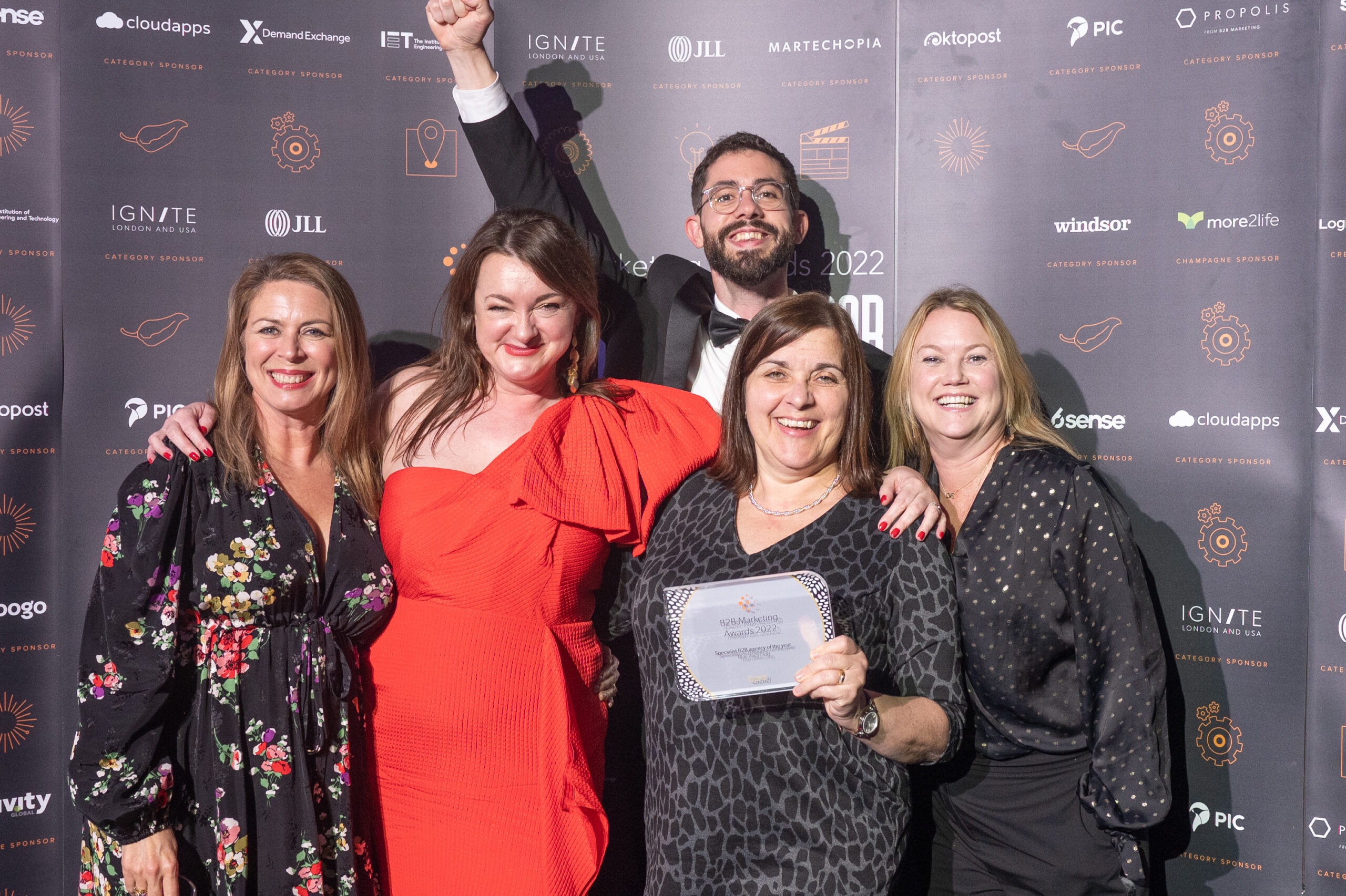
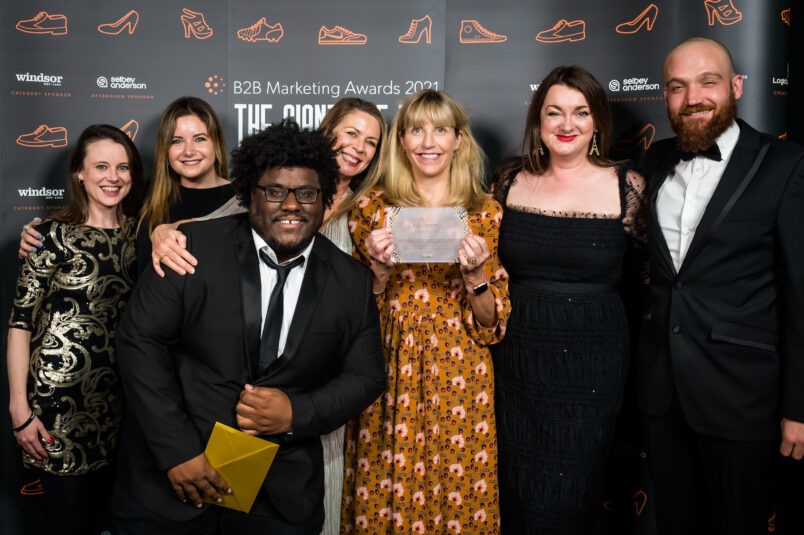
Man Bites Dog has been named Specialist Consultancy of the year in the B2B Marketing Awards.
Our award-winning Zeronomics campaign for Standard Chartered is a cornerstone example of the storytelling, positioning and strategic work we do at Man Bites Dog.

Man Bites Dog recently partnered with Women in Journalism to conduct a major new study on gender inequality in UK journalism and media.

For some years now, we have been campaigning to close The Gender Say Gap, a term we coined to highlight the invisibility of women and diverse leaders as expert authorities in business and public life.







Head Office
Moore House
13 Black Lion Street
Brighton
United Kingdom
BN1 1ND
London Office
24/25 The Shard
32 London Bridge Street
London
United Kingdom
SE1 9SG

+44 (0) 1273 716 820
[email protected]
Man Bites Dog Ltd. is a company registered in England and Wales with company number 05156769. Registered office: Moore House, 13 Black Lion St, Brighton and Hove, Brighton BN1 1ND. VAT No: GB854451518.