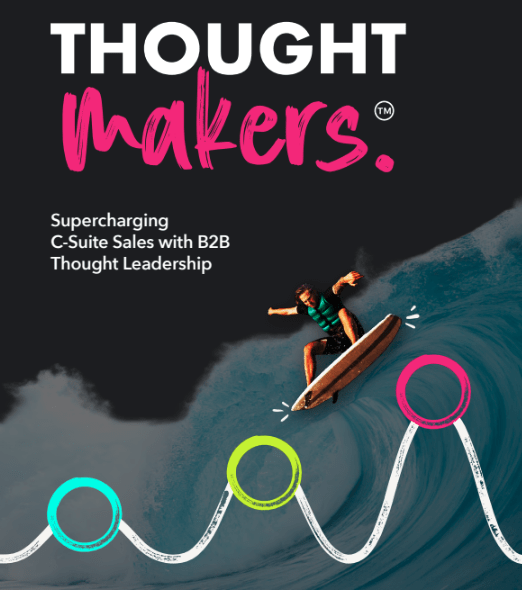
Thought Makers: Supercharging C-Suite Sales with B2B Thought Leadership
Find out how you can use thought leadership to supercharge brand and sales.
Man Bites Dog recently joined the Financial Services Forum, and have taken advantage of our membership by attending a series of fascinating events and seminars focusing on the biggest issues facing the financial marketing community.
A recurring theme that continues to challenge financial services companies is brand differentiation. Because so many firms are trying to differentiate purely on services, experience, people, or the global footprint of the business when there is significant overlap with competitors - to their customers most financial services businesses look and sound the same.
Our own research has shown that 90% of B2B marketers believe their company needs to differentiate from competitors based on their thinking and ideas, as senior business audiences are only willing to trade their time for genuinely new insight. They want original ideas that really grab them, not me-too thinking. So how do you practically do that?
To develop a differentiating marketing strategy, these three key steps will ensure you stand apart from the competition, giving you the competitive edge to attract your prospects and win in your category.
This sounds like an existential question, but it’s a problem facing every financial services firm. As companies have become entrenched in their markets and have become protectionist rather than forward looking, they have lost sight of why their business came to be.
Amongst the complexity of processes and systems that developed over time to create a matrix of activity, businesses can lose sight of how they became successful in the first place.
Your first job in finding differentiation is understand why your business exists. This is unique - as every business formed for different reasons, in different markets, by and for different people - and if it’s unique, it’s not something anyone else can copy.
You need to find the fundamental values of your business and what it does truly differently that differentiates it. Don’t kid yourself - be honest - because there’s no fooling your customers.
At the heart of your business and what makes it successful are your customers. There are individual reasons, both rational and emotional your customers chose you over your competitors, and you can use this insight to power your purpose and marketing strategy to help prospects understand who you are and why you’re a great choice.
The best way of find out what has made you a success is to ask your customers what they really think of you, and for you to get under the skin of who they are really so you can understand how to reach out to customers and prospects more effectively.
You need to know what their problems are, rather than what you want their problems to be. And by talking to the heart of the issues they face you can truly create an idea they can get behind.
Create insight based on segments of your customers so you can identify solutions that are bespoke to each group, and talk to them separately rather than assuming they are one homogenous group.
Once you’ve understood your reason for being, and cross referenced that with customer segments based on real insight, you’ll be in pole position to understand where your natural fit is in your market.
Too many companies fall into the trap of wanting everyone to be their customer, and target so broadly that it no longer qualifies as targeting. So prioritise your target audiences based on their needs and create campaigns for each of them.
This doesn’t have to be limiting. A good, strategically sound campaign can cross continents, diverse business types, and companies with starkly different objectives, and still communicate real value in seemingly disparate groups.
There are fundamentals which tie all of your customers together, and by tailoring your messaging to different markets you will create true relevance for your target market from a single idea, focussing your marketing in a commercially effective way.
To find out more about how we generate award-winning ideas that sell, contact us today at [email protected].
A UK Government Minister has publicly criticised corporates that are threatening to pull out of Britain over Brexit, branding last week’s comments by Airbus “completely inappropriate.” In an unprecedented move, the public was urged to stop our ears and ignore the “siren voices” of multinational employers making public interventions in politics.
But are these siren voices an inappropriate distraction, or are business leaders sounding a valuable note of warning, a lighthouse steering us clear of the rocks?
The separation of business and politics has long been considered sacrosanct. While companies lobby to influence specific industry and legislative issues, at a macro policy level they generally aspire to be nonpartisan.
Political bias can alienate employees and customers alike, and in extreme cases it can affect the favourability of the regulatory environment and a company’s license to operate. What’s more, in our digital times an outspoken opinion can set an expectation that lasts a lifetime.
Against this context of political neutrality, we’ve seen the rise and rise of corporate values. These principles have become as entrenched as a corporate religion, a code which governs behaviour, culture and the norms by which companies operate.
Values generate followers, conveying competitive advantage in attracting customers and talent, with employees accepting lower salaries or fewer tangible benefits for an employer brand they identify with. But organisations that profit from their values will pay a high price if they fall short of their promises.
It’s no surprise that corporates have remained conspicuously nonpartisan for years, but when political ideologies are becoming increasingly polarised, the question is whether it’s possible (or even desirable) for companies to remain apolitical?
As political agendas move from shades of grey to harsh clashing colours, we are witnessing a shift towards ‘uncorporate communications’ where leaders are willing to speak out as representatives of their company to protect their brand’s core values and influence issues which have a direct impact on their business and their responsibilities to their employees and supply chain.
The gravity of Brexit may have been the first political issue to coax British business leaders off the fence in decades – and may set a new blueprint for corporate values and behaviour.
We’ve seen the rise of the digital resistance in the US as Tech CEOs have united to oppose immigration policy from the ‘travel ban’ to the separation of families at the Mexican border. Multinational companies have moved to defend not just the free movement of labour they need to operate, but the liberal democratic values their employees align with. This is a significant movement with global implications: business sirens are highlighting not only the issues that affect them directly, but taking a stance to make political change in the world.
We are now entering uncharted territory. In this polarised political environment, remaining in the neutral zone is almost impossible for companies that trade on their values as an intrinsic part of their operating model.
Leaders need to decide where their company stands on the most critical political issues, and identify the lines that cannot be crossed. The days of corporate neutrality may be numbered.
The great opportunity that comes from building marketing campaigns in 2018, is that the power of word-of-mouth has reached epic proportions. The title of this blog is evidence of that very phenomenon.
The quote “if you build it, they will come”, is wrong. The actual quote from Field of Dreams is “if you build it, he will come”. But the misquote got used a few times in the early days of the internet and took hold. If you search for the misquote today you get 2.2 million results – the real quote gets just under one twentieth of that number.
Fuelled by Google’s drive to centre SEO around what people actually engage with and share, the way marketers can light a fire under an idea has changed. So it’s time to update the adage that we in marcomms have been celebrating for years; strictly speaking, content is no longer king, engagement is.
Content is dead... long live engagement
When people buy into, spend time with, and then share your content at scale, it’s easier to connect the dots between what is clearly on the page and sought after on-site metrics. But one-to-many content, in the traditional sense, isn’t enough.
To generate real value, marketers need to build something that is not only highly targeted, but highly useful to the target group. It is the real value that creates highly shareable content, rather than old-hat SEO tricks to fool search engines into thinking this content is relevant.
It is the user, in real-time, who is gauging relevance and applicability to each other person in that market, whether they have the exact same challenges and ambitions or not. Fundamentally, those are the reasons people bought into and shared your content in the first place - not because you wrote it - but because it’s engaging.
Sure, there are things you can do to bring your content more in line with the microcosms within your audience, but there’s also the potential to go much further.
Never be content with your content
But what blanket changes should we be making to content to help it thrive on an internet that’s increasingly fussy?
Content as it used to exist is too big, too long, and too boring. Who needs a hundred articles, all written from a self-serving perspective, on ‘what GDPR means for your business’? You only need one article, that is relevant to the industry to you’re in and what your business does.
Some say that attention spans have dramatically slumped in the age of smartphones and microblogging, but it’s only half the story to say it’s purely down to the quantity of information. The other half is that people aren’t interested in consuming information that isn’t relevant to them. There’s a universal glut of information designed to capture traffic in high volume, and it’s literally impossible to read it all. So why would we burden ourselves with things that we don’t value and that don’t help us as individuals?
At a basic level, it means that content should be broken down so it’s easily accessible based on who’s reading it, segmenting your audience for highest relevance. Though breaking content down into trend pages and chapters on “millennials” or “fintech SMEs”, for structure and clarity - you can take it one step further.
If the user can break the content into digestible pieces themselves, and it’s easily navigable, you’ve solved the content problem and the audience problem in one fell swoop. Why? Because no segmented audience ever conforms exactly to the profile you’ve assigned it, but individuals know what it is they’re looking for.
It’s about creating choice. And by allowing a smooth process to allow the choice, and capturing the traffic all in one place, you’ve shown Google what fantastic content looks like, increasing the organic traffic to your site.
Always on, always bespoke
Once we dive beneath the level of audience segmentation and start to understand the needs, wants, and ambitions of individuals, we create content that blurs the line between driving awareness of your company and creating a valuable sales pipeline.
To take an example from our work with a major international bank last year, we wanted to show entrepreneurs in emerging markets that by using a more sophisticated savings approach, they could make their money work much harder for them; building their wealth, reaching their personal goals faster, and maybe even retiring earlier.
Hooking them with headline figures – the amount they were missing out on – got their attention, but rather than facing them with a behemoth research paper for them to get lost in, we invited them to tell us who they were and where, and to see exactly what the situation was for others like them, in their country.
This interactive digital experience outlining the challenges they faced, gave them an understanding of the direct benefit of talking about developing a financial strategy with our client. Awareness through to sales, all in one place, relevant to everyone in the target group.
Connect your products with your audiences using a single message
Many companies have complex products to sell in complex businesses and industries, and have created nuanced marketing plans to traverse and communicate these complexities to their audiences.
But products are designed to meet very specific needs. Though it’s difficult to cut through the noise and show customers why the product is important to them in a differentiated way, it can be done.
By finding a clear central narrative which pulls these complexities together, and coupling it with interactive digital tools, brands can talk one-on-one to large groups of customers in a relevant, engaging, and differentiated way. And with online interactions being constantly monitored by search engines and shared among engaged users - making the connection between product and user engagement - you can pull traffic directly into your sales funnel organically.
To speak to us about the conversations you need to have with your customers, and how they might be enriched, get in touch today.
Good PR isn’t just about having something worthwhile to say, it’s about making sure you reach the people who are most interested in what you’re saying. And with more and more noise to cut through, you need to find new and innovative ways of reaching your audience.
Optimising your website and content for search engines has become a huge opportunity for capturing people interested in what you’re saying. But why is it important, and how does it work?
The PR Google opportunity
Behind the coveted space at the top of every Google search, lays an algorithm that curates websites into a hierarchy through a quality over quantity equation, continuously building a profile of all web sources. The best receive the highest visibility, and consequently, the highest amount of organic traffic.
The Google philosophy is simple: by creating real value for your users, you will be rewarded with web content at the top of the search engine results page (SERP). Due to the link between the user search query and website content, link farming, keyword stuffing and other ‘black hat’ techniques once muddied the internet with spam pages aiming to top the Google charts.
But this is no longer the case. Updates such as Penguin and Panda focused on reducing the value of low quality sites, thereby removing them from SERPs and resigning them to history. These changes also mean that keyword research is no longer enough. As the backbone of all successful marketing, and as Forbes’ ‘PR theme of 2018’, it comes as no surprise that trust is the crucial and binding factor behind the growing alignment of SEO and PR.
And with Google’s focus on user experience as a core indicator of quality content, in the future, marketers and PR professionals need to build their websites with this in mind to make sure they reach the people they are targeting to their full potential.
Power your digital marketing strategy
Building trustworthy content will improve key algorithm signals such as the time someone spends on your website, which increases the likelihood of the next person finding it. And the visibility of web interactions means that the success of a SEO aligned PR strategy is directly measurable through metrics such as the amount of organic traffic a web page gets.
Symbiotically, social media also helps spread engaging and useful content organically. While this is also measurable through the number of likes, comments and shares that it receives, each interaction in turn shows Google how good your content really is, in real-life contexts, increasing its page score.
So building content that people believe in and get behind, can provide competitive advantage in the digital space, and differentiate you from the crowd of businesses all focused on the same thing; maximising organic traffic volumes.
Key SEO tools
But for maximum effect, the old and new approaches should work together. Once you have created unique and engaging content, there are a number of tools you can use to maximise organic search visibility.
Many of these are free and easy to use, and help to gain audience insight to find out what your audience is searching, assist in optimisation through timing and keywords, and help you to gauge the success of a strategy once it is implemented to see how it can be improved in the future.
Google Keyword Planner – part of Google AdWords, keyword planner helps to find keywords related to the subject you’re talking about, and get search volume data to scope the opportunity
Answer the Public – a fantastic tool for generating ideas for content, particularly for getting traffic to news articles and blog posts
Google Trends – timing is key, and this tool helps you see the peaks and troughs in topic trends that will help get most traffic to your post
SEO Moz – a tool that connects your SEO activity with changes in domain and page authority, a core success metric. The downloadable toolbar is free to use
Google Analytics – a free service that tracks and reports on all traffic that lands on your site, crucially where the traffic comes from. You can set up goals to understand revenue and every metric in between
Search Metrics – a tool that helps to determine a domain’s visibility through metrics of uniqueness – good for planning domain names
Stand out from the crowd
At Man Bites Dog we create end-to-end marketing strategies. From creating a great idea that will engage your audience to delivering a marketing plan to maximise the reach of your message.
We specialise not only in having something unique to say to your industry, but also in getting your message heard. Get in touch today to discuss your PR and digital marketing strategy.
Find out how you can use thought leadership to supercharge brand and sales.

Man Bites Dog has been named Specialist Consultancy of the year in the B2B Marketing Awards.

Our award-winning Zeronomics campaign for Standard Chartered is a cornerstone example of the storytelling, positioning and strategic work we do at Man Bites Dog.

Man Bites Dog recently partnered with Women in Journalism to conduct a major new study on gender inequality in UK journalism and media.

For some years now, we have been campaigning to close The Gender Say Gap, a term we coined to highlight the invisibility of women and diverse leaders as expert authorities in business and public life.





Head Office
Moore House
13 Black Lion Street
Brighton
United Kingdom
BN1 1ND
London Office
24/25 The Shard
32 London Bridge Street
London
United Kingdom
SE1 9SG

+44 (0) 1273 716 820
[email protected]
Man Bites Dog Ltd. is a company registered in England and Wales with company number 05156769. Registered office: Moore House, 13 Black Lion St, Brighton and Hove, Brighton BN1 1ND. VAT No: GB854451518.