
Thought Makers: Supercharging C-Suite Sales with B2B Thought Leadership
Find out how you can use thought leadership to supercharge brand and sales.
Over the last few years the environment has been engaged in a hostile takeover of the global news agenda, and it’s working. Earlier this year the UN Development Programme (UNDP) surveyed over a million people around the world and found that the vast majority (two thirds) believed there is a climate emergency. Whether younger or older, whether in the UK, South Africa or Japan the story was the same. What’s more, most people were willing to support climate action even when it required significant changes in their own country.
For investors the same story is playing out, whether you look at the flood of green bonds appearing on the market or the three quarters of investors planning to increase their share of ESG investments this year.

Green screen
For marketers the good news comes hand in hand with the bad. With so much passion for the environment, authentic, well founded marketing that showcases the genuine green credentials of a progressive business can be a powerful lever of growth. On the other hand, the bandwagon is crowded, and often with those whose actions don’t live up to their words.
Greenwashing is pervasive across a number of industries and as a result it’s easy for genuinely progressive firms to get tarred with the greenwashing brush. Even without the threat of the greenwashing label, finding white space that your brand can own in this ever more crowded market is only getting harder, yet all the while the rewards for successfully doing so increase exponentially.
The question: how do you find your own unique white space, and at the same time demonstrate the authenticity of what you have to say? To do so is no simple challenge. There are however a few guiding principles to start with:
Progress, not promises
Firstly – and this should go without saying – you can’t market it if you don’t have it. If your business doesn’t have a plan to reach net zero; to aggressively improve its impact on the environment; or better still to facilitate a host of other people and organisations to improve their impact, then the journey doesn’t start with a marketing campaign.
If you haven’t already made some progress, then to talk about future plans sounds hollow. Equally, you can’t highlight a problem that you can help fix, if you haven’t already gone some way towards fixing it within your own organisation. Progress comes before promises. If you have grand ambitions that you can’t back up with demonstrable achievements, that’s greenwashing, no matter how good your intentions.
Challenging, not cheerleading
The planet – at least as far as humans are concerned – is in grave danger, and an unprecedented amount of progress is required to turn the situation around. That isn’t something that is going to change this decade. Celebrating small wins is great, and it’s all part of the journey, but only in the context of the gargantuan challenge that remains.
The most direct route to finding unique white space within the green agenda is to understand a unique aspect of the problem that isn’t garnering the attention it deserves and to demonstrate why it needs focus and how we can begin to tackle it. That’s exactly what Standard Chartered recently did with their successful Carbon Dated campaign by highlighting the problem of multinational corporations shunting emissions reduction efforts down their supply chains. And what Law Firm Addleshaw Goddard explored in their Pain to Net Gain campaign revealing a major sustainable financing threshold just four years away.
Lead, don’t follow
Thinking inside the box will never deliver the kind of profitable white space CMO’s crave. A great many organisations offer their take on some of the biggest and most debated challenges of the climate emergency, but that kind of thinking doesn’t cut through the noise.
All too often asset managers and other financial institutions produce ‘me too’ content on ESG investments and other sustainable finance initiatives. Investors are bombarded with it and journalists are bored of it.
To truly lead the conversation, brands must project the climate challenge forward, uncover the unforeseen challenges that tomorrow will hold and relate them back to the business pressures that we face today. Only then can they truly break new ground.
If you’re interested in hearing more about how your business can discover and claim its own white space in the all-important climate debate, highlight your own role as a stakeholder in global carbon transition, get in touch with me directly at [email protected] or reach out to us: [email protected]
The logic chain of carbon reduction sounds straightforward and it goes like this: Carbon is bad, reducing carbon is good; therefore companies that produce a lot of carbon emissions are bad, and reducing these companies is good. Simple.
To a large extent, that sums up the philosophy of the environmentally-minded investment community, and particularly the big institutional investors which control swathes of global capital. Just the other day, three of New York’s vast public employee pension funds divested $4 billion from securities related to fossil fuel companies in a move that most would view as commendable, if not vital for the future of our planet.
A Carbon Admission
However, as several people, including Mark Carney, have been at pains to admit, the world can’t simply switch off fossil fuels and switch on green energy. Energy infrastructure is in the expert hands of energy companies, and these have all until recently been heavily reliant on the only form of energy that was cost effective: carbon.
By divesting money and support from fossil fuel businesses and instead supporting green businesses, we are helping the growth of the green tech sector and supporting sustainability, but are we helping the world transition quickly and efficiently away from its carbon habit? Probably not.
On the other hand, are we willing to carry on blindly supporting fossil fuel businesses in the vague hope that they channel our support into rapid transition activities? Heck no. So how do we know where to get the best environmental return on investment? How do we know who the high potential, high impact “greening” businesses are, not just the already “green” businesses who lack the same potential to accelerate transition. More to the point, how do we distinguish greening businesses from the laggards without the meaningful intent to speed their transition?
The Communication Challenge
This is among the critical challenges that marketers and communicators now face: how do we effectively reflect the strategy and genuine intent of greening businesses and show the world who they are and what they are striving to achieve?
The importance of this communications challenge extends well beyond the investment community, or even business leaders. It extends right down to the engagement of each individual worker on the factory floor. Bernard Looney, CEO of bp, likes to tell the story of the oil refinery worker he met on a visit who personally thanked Mr Looney for bp’s Net Zero by 2050 strategy – a policy that would ultimately make his skillset redundant, but that he knew would make the world his children will inherit a better place.
It is this broad engagement with the subject of the environment that places so much potential, and also so much risk, with the communicator.
Greenwashing
Amid the efforts to communicate the virtues of earnest transition there is also the harsh reality of greenwashing, where insincere or lacklustre environmental efforts are passed off as more than they are. However, it could be argued that the threat of being labelled as “greenwashers” is a valuable incentive for communications teams as it forces businesses to leave no ambiguity. Instead they must underline all that they say with firm evidence of their intent, their approach and their progress.
This is a challenge and an opportunity that puts marketers at the centre of a historical pivot. By effectively communicating the genuine efforts of the critically important “greening” businesses, and distinguishing them from the hollow words of the greenwashers, the marketing community has the potential to become the stewards of transition, signposting investment and raising standards, to facilitate the realisation of a net zero economy.
If you’re interested in hearing more about how your business can fit into this conversation and highlight your own role as a green or greening stakeholder in global carbon transition, get in touch with me directly at [email protected] or reach out to us: [email protected]
“Abandon hope all ye who enter here” has become the unofficial maxim of most stock exchanges since March when the FTSE tumbled towards a low of 4,800 points and the Dow Jones saw the three worst point drops in its history.
Broader economic measures haven’t offered much optimism either – if I made a wordcloud of my news alerts over the past fortnight, it would mostly feature the word ‘contraction’ in a soup of negative adjectives.
It’s already a truism that we’re undergoing an unprecedented – and in part irrevocable – change to how societies and economies operate. While there may be some positive impacts in the long-term, from an investment perspective, there is one area in particular that is set to suffer.
ESG (environmental, social & governance) investing is one of the most likely victims of the financial shockwaves from COVID-19. Yet, immediately before the crisis took hold, this sector was flourishing, with a record 479 green bonds issued in 2019. It was only in January of this year that Blackrock’s Larry Fink – in characteristically straight-talking fashion – said that climate change had become a “defining factor in companies’ long-term prospects”. In fact, evidence for the approaching heyday of ESG was everywhere, from a January study showing that investors will pay more for stocks in companies that give to charity, to a 2020 ETF (exchange-traded funds) study showing that 74% of global investors planned to increase their ESG asset allocation over the next year. But given the current context, how many of these plans are likely to remain intact?
With a global downturn not only likely, but threatening to out-plummet the crash of 2008, how much goodwill is left for ESG? The natural reaction for many will be to refocus on short-term gains, to rebuild portfolios and make up the loss: a return to the stark profit motive. Unfortunately many ESG investments are long-term, carrying risk and uncertainty aplenty.
So is it really the case that a small mutation in a hitherto unheard of virus could derail the global environmental and social momentum we’ve been awaiting for decades? Well, yes, it looks that way. But is it a foregone conclusion? Perhaps not.
It depends, to some extent, on us marketers.
Driving a green recovery
The COVID-19 crisis has caused immeasurable suffering but, from an environmental perspective at least, it has not been without its glimmers of hope. From dramatic improvements in air and water quality to the emergence of seldom seen wildlife, we’ve seen a glimpse of a world less choked by pollution. We’ve also seen unprecedented changes to our own activity, having been forced to radically redefine our relationship with travel and consumption. These behaviour changes were once thought impossible, but have – for now at least – become the reality.
However, these positives have quite naturally been drowned out by the weight of bad news and, as the below graphic from reputation intelligence specialist Polecat shows, the extent to which climate change (in blue) has been pushed down the agenda by COVID-19 (in solid grey) should not be underestimated. And that’s where we communicators come in.
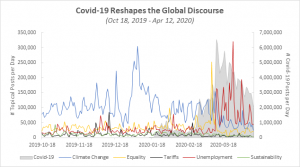
As Bill Gates noted in a recent Economist article, the lasting impact of COVID-19 on the world will not be defined by our response so far, but in how the world reacts over the months ahead.
Financial services marketers, from asset managers to global banks, now have a unique opportunity to put a stake in the ground, pinning their firms’ reputations to a progressive agenda that sees COVID-19 as a chance to reset the dial and drive a green recovery. Instead of setting progress back years, it’s possible to advocate for a response to the downturn that centres on recognising the transformative lessons of the crisis and locking-in the best of those learnings when we rebuild our economies.
Without influence, it’s all too likely that old habits will resurface and the stark profit motive will take precedence, at least until the aftermath has started to clear, by which time the opportunity for lasting change will be lost.
The stage is now set for pioneering financial institutions and investment houses to lead substantial thought leadership campaigns that put their weight behind a far more positive response, connecting capital to positive change that could redirect us to a green recovery. If that happens – if we, as financial services marketers, succeed in making it happen – our actions will echo around the world.
If you’d like to talk about what such a campaign could look like, and how it could move the needle for your reputation, drop me a note at [email protected] or email [email protected].
Find out how you can use thought leadership to supercharge brand and sales.

Man Bites Dog has been named Specialist Consultancy of the year in the B2B Marketing Awards.

Our award-winning Zeronomics campaign for Standard Chartered is a cornerstone example of the storytelling, positioning and strategic work we do at Man Bites Dog.

Man Bites Dog recently partnered with Women in Journalism to conduct a major new study on gender inequality in UK journalism and media.

For some years now, we have been campaigning to close The Gender Say Gap, a term we coined to highlight the invisibility of women and diverse leaders as expert authorities in business and public life.




Head Office
Moore House
13 Black Lion Street
Brighton
United Kingdom
BN1 1ND
London Office
24/25 The Shard
32 London Bridge Street
London
United Kingdom
SE1 9SG

+44 (0) 1273 716 820
[email protected]
Man Bites Dog Ltd. is a company registered in England and Wales with company number 05156769. Registered office: Moore House, 13 Black Lion St, Brighton and Hove, Brighton BN1 1ND. VAT No: GB854451518.